All Posts By

admin

Running the Numbers by Chris Jordan

By features

Escaping the vortex of comfortable yet damaging habits is a great challenge, but change is harder to think about than to face. Chris Jordan knows this well. At 40 he chooses to leave a law career and the culture of consumerism that he used to defend becomes the subject of his art.

Inspired by the works of Andreas Gursky and Richard Misrach, he studies large format photography, attracted by the superior quality of detail.
As a post-modern archaeologist, he explores ports, industrial areas, landfills, on location and in studio. The more he sees, the more he perceives the contradictions, confusion and absurdity of what he calls “a slow-motion apocalypse”.

In front of his photographs, it’s impossible to remain oblivious. Choreographed and interpreted with great artistic sensitivity, Jordan’s works denounce a growing degradation. From a distance, his images seduce the eye, while up close they spark the mind and engage the heart.

“I belong to a community of thinkers, artists, poets and scientists who are aware of how unsustainable our present model of consumption has become – but we’re on the margins of society: at the center there is an immensely powerful machine controlled by industry, oil companies and politicians, people who live in total denial and just don’t see how devastating the effects of consumerism are, not only for nature but also for the human psyche” says Jordan.

Running the Numbers and Running the Numbers II, ongoing series from 2006, look at contemporary American culture through the austere lens of statistics. A collective voracity that nobody wants to be responsible for. “People enjoy discovering the multiple layers of my images”, says Chris.
“During exhibits they ask questions, get passionate and upset, but their motivation is like the stroke of an oar: it creates a whirlpool that slowly expands and disappears in the current.”

We know we’re destroying the planet yet collectively nothing seems to change. The cumulative effects of mass consumption are not sustainable. Only our conscience can evaluate the damage, choosing to care and to believe that our daily actions matter.
Albatross by Chris Jordan

By ecology, sdg 12, sdg 15

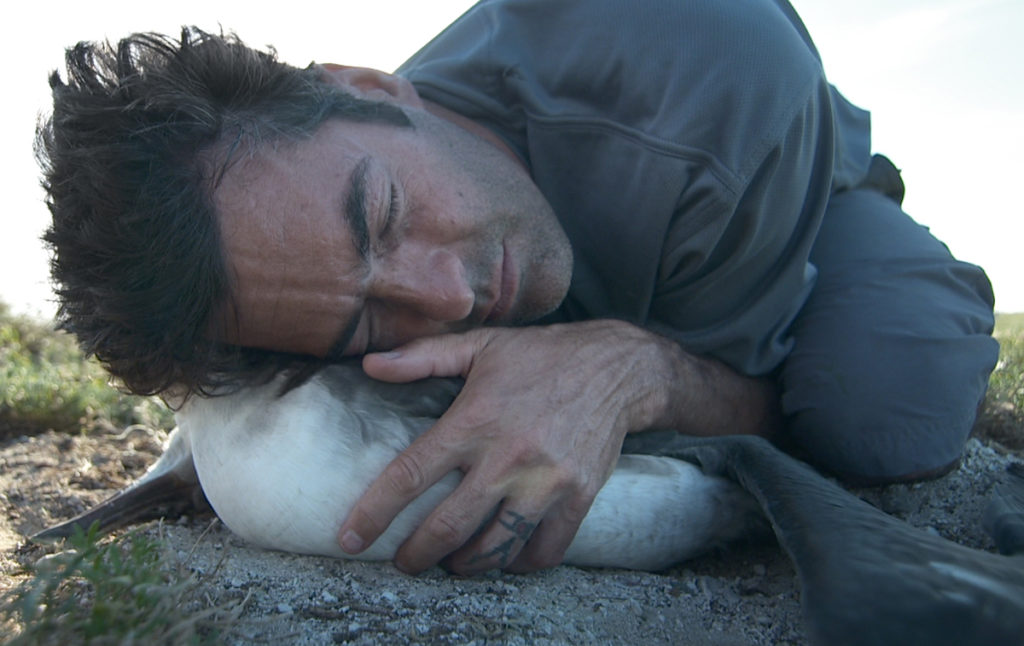
The American artist and filmmaker Chris Jordan faces us with a reality that is physically remote but that we unconsciously contribute to. During numerous journeys to Midway Island, the farthest from any continent, he found something that we all should relate to. His hope is that we cross the threshold with him, as an act of collective consciousness.

Albatross can be watched for free at: www.albatrossthefilm.com


Chris Jordan: The first time I went I only saw the dead birds, so i experienced the island as a kind of silent horrible killing field and I’ll never forget the moment of stepping off the plane the second time as the door opened, instead of being met with silence and the smell of death, i was met with a million of these magnificent beings, dancing and singing all day long and all night long.

Cristina: It took you eight years to really complete the journey both outward and inward what were the key turning points in that process?

Chris Jordan: Being with the birds as they died as they choked to death on plastic and as they died of the toxicity and as they starved to death even though their stomachs were completely full of plastic, it happened over and over again i was with them in that moment and I experienced far more feeling than i thought i ever would. And as grief washed over me in waves time after time i had this transformational experience of realizing that grief is not a bad experience. Grief is not the same as sadness or despair or depression. Grief is the love that we feel for a being that we love that we’re losing or that is suffering.

Cristina: And did you find that that love transferred to the celebration of life as well?

Chris Jordan: It connected me with something that i didn’t even know i had in me which is the love that i feel for the miracle of life

Cristina: Your film is traveling the world, what are the reactions that you’ve seen so far and what do you hope that, overall, people will take from it?

Chris Jordan: It’s been amazing to share it with audiences from all over the world. I find everywhere that people are craving to reconnect with the essential part of ourselves, the deepest part of ourselves, that loves our world, and loves each other and and that loves life.

Robots and us, a journey in Japan

By features, technology

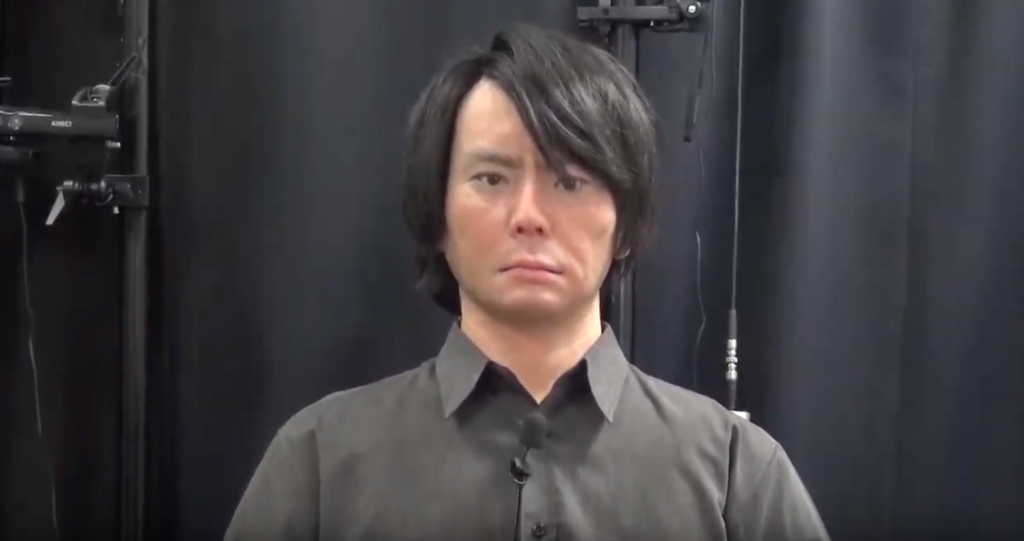
This is a preview of the trip in Japan where I met scientists and designers who are pushing the boundaries of robotics.

ROBOT: Yeah, I am so happy.

CRISTINA: Are you ever lonely?

ROBOT: Yeah, at night I am very lonely. I am very lonely.

SHIGURE: Humans always, you know, feel some pressure from other persons. But androids are very clean, you know, well, it’s a robot, right, and people can easily trust a robot. The purpose of this robot is to monitor elderly people. Kobian can communicate with its entire body, or just with its face. That’s the communication robot. It will be an important part of our society within ten years, or something like this. This robot is developed to monitor environment, and to monitor disaster areas, like Fukushima.

The power of trash

By ecology, sdg 11, sdg 12, sdg 13, sdg 14, sdg 15, sdg 17, sdg 7, sdg 9, technology

Arthur Huang, architect, engineer and CEO of Miniwiz explains his processes and machines to use the most abundant resource on our planet: trash! Trashpresso, a portable solar-powered recycling machine was in Milan’s Parco Sempione during the Salone Internazionale del Mobile 2018.

PART I

Cristina: Arthur, what is the power of trash for you?

Arthur Huang: It is the most abundant resource that’s out there right now. It’s in our ocean, it’s in our water, it’s even in the glacier at 4.900m. This trash resource is growing so I think we need to do something about it to power our new way of designing and our lifestyle.

Cristina: You are doing something about it. How many systems have you designed?

Arthur Huang: We actually designed 1.200 new processes and they come with 4 big categories of machinery, which can sort and transform the material from the original raw source of trash that we throw away every day from cups, bottles, packaging, all the way to waste fiber. From these four major categories we can go into lots of different variations of pre-fabricated material for designers and engineers to be able to use in building construction or for products.

Cristina: You’re wearing a number of your new materials. Can you point them out?

Arthur Huang: This is 100% single material, without glue in it, it’s made 100% from plastic bottles. This is also made with 100% plastic bottles but it feels like wool. The shoes are also made from recycled PET. Even the buttons and the sunglasses and the watch strap are made from cigarette butts. This button was made from four butts, that we collected from Switzerland and Italy and we’re turning into a new form of buttons and hardware and sunglasses. These are the sunglasses.

Cristina: And how much energy does it take to actually strip some of these materials from their toxic elements?

Arthur Huang: It is actually much easier than you think, that’s why we designed the portable machine called Trashpresso, to demonstrate how little energy is used. All of the machines are actually powered by the sun, all the water and air is internally recycled, so we want to show people that the transformation process actually requires very little energy, as little energy as possible. You get a 90% savings in energy in the transformation, rather than going out there into the ocean, taking out the oil, producing that and transforming it into raw material.

Cristina: There are no toxins left in the the cigarette button?

Arthur Huang: Actually we did a whole set of safety tests and there isn’t anything left in the cigarette butts after the transformation process, there are some fumes, but they’re captured by the machine. A lot of times during the transformation process the toxins are actually already exposed in terms of fume.

PART II

Cristina: We’re reading on the papers that there’s more recycled materials than the market demands, so this is a critical issue, and people are burning these stocks of transformed trash. How can your strategy and your system have an impact on a global scale?

Arthur Huang: First of all, most of our systems are designed to be portable. I think this is very important, you need to take the transformation technology as close to the trash source as possible. Most of the problem today is that when you recycle, you mix the materials. Once you get contamination, the material has no value, once the material has no value, the transformation process has become very expensive and it also becomes more environmentally damaging. The idea is to bring the machine as close to the source as possible and then you can transform it into a medium that the designers and engineers can work with on site.

Cristina: From your experience where are the missing links to be able to harness all this expertise, intelligence and solutions?

Arthur Huang: The missing link is the recycling process itself, you need to know how to sort the trash. That’s the first question. All the recycled materials out there, no matter how much percentage you collect, in reality only less than 2% is being used to be turned into some sort of recycled substitute material. And then on top of that, after you know how to sort and process the material, you have to know how to form it. And there is the whole transformation process with all the different data that’s needed. You also need application, is it going to go into shoes? Jackets? Is it going into a chair, or a building? These all have different specifications, so right now all that missing link of data is what we are working on. We are opening up a material database with 1.200 new materials in it to open source data from our learning in the last 15 years to give to institutions for education so young designers and engineers can play with the material. So we are trying to fill the missing link with data.

Cristina: What is your moonshot?

Arthur Huang: Our moonshot right now is to build an airplane made out of trash. We actually bought an airplane from Germany and we shipped it to Taiwan and now we’re actually trying to come up with a new process to build an airplane wing made from recycled PET.

Tooteko – a tactile conversation with art for the blind

By sdg 10, sdg 9, technology

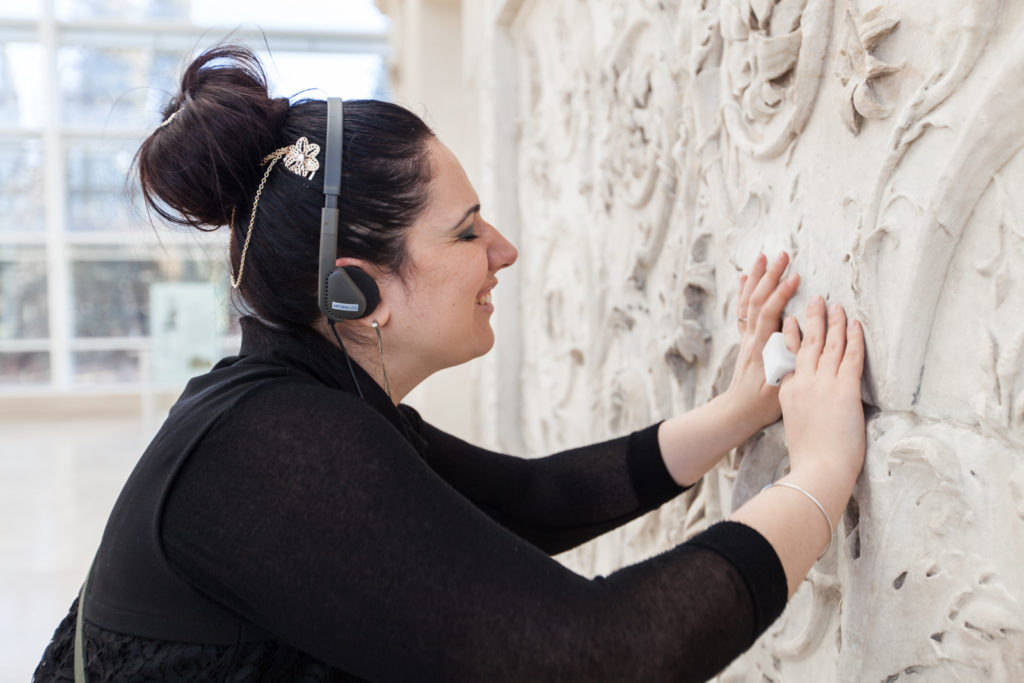
Tooteko is a thesis project turned reality. Serena Ruffato, CEO, explains how their device works: making art accessible to the blind and visually impaired by integrating tactile exploration with audio data. Deborah Tramentozzi shares her experience of a Canova statue with me.

Cristina: We’re in Rome in a space that is now a restaurant, but was once the studio of Antonio Canova. We’re here to tell you about a technological application that’s also an important human experience. Serena, how does the application you created work?

Serena Ruffato: This technology combines audio and touch to allow everyone, even the blind, to experience works of art. It uses this ring, an NFC sensor reader, to recognize the sensors we place on the art work and transmits audio information to a smartphone.

Cristina: Altering the art means that you work with copies.

Serena Ruffato: Absolutely, we take the original piece, select it, scan it, reproduce it with 3D printing and then apply our sensors.

Cristina: Deborah, tell us how you’re equipped to live this experience and what it tells you.

Deborah Tramentozzi: I’m wearing this ring, which has an antenna inside it. This antenna communicates with a tag that is placed here on the statue, which I will now touch with a finger. The moment I put it on the tag, the ring emits a vibration and communicates with the smartphone. Which will start an audio guide. Now I’ll show you how it works. This technology, by connecting the two senses that I use best – touch and hearing – allows me to have a vision, I like to call it that, of the work of art without any filters. I come from an artistic environment, so I have always experienced guided tours through the filter of another person, who gave me an idea allowing me to interpret the work of art. This way, it’s me and my personality who get an idea of ​​the work of art and I can literally see just how each of you would. I think this is a great gift because giving the blind the independence and freedom to choose to enter a museum, something that is second nature to everyone, for me is truly a frontier that I thought would be impossible. Can I ask you to close your eyes, and I’ll start the next tag and touch the statue with you?

Cristina: Absolutely, thank you. It’s exciting, because it also allows me to enter into a kind of empathic resonance with Deborah’s experience. We hope that this project will allow as many people as possible to experience art in this new way. Occhio al futuro

On air November 17, 2018

A trip to the future with Cristina Pozzi

By sdg 16, sdg 17, sdg 8, sdg 9, technology

Does your head spin when you think about the future of work, society and family? I went on a short trip with Cristina Pozzi, author of 2050 Guida (fu)turistica per viaggiatori nel tempo [2050 (Fu)Turistic guide for time travelers]. Cristina is also the founder of  Impactscool, which brings training courses to Italian schools and universities, preparing for the big changes taking place.

Cristina: What are the changes that await us in the coming years? Cristina you’re a social entrepreneur and writer and you traveled into the future. What did you see?

Cristina Pozzi: The future I saw in 2050 is one where the environment in which we live changes because, alas, due to climate change, our planet will be subject to many changes, but also the same concept of family could be questioned, mutate, evolve, due to the evolution of genetics. For example, children could have three parents born by using the genetic material of all three, it has already been done in England.

Cristina: How are we going to increase our cognitive skills?

Cristina Pozzi: We can do it in many ways, both from a chemical point of view with medicines that are being studied to increase our attention and also with so-called neurotechnologies – we can have implants or helmets to wear that increase our creativity.

Cristina: And what if they are not within everyone’s reach because of the cost?

Cristina Pozzi: Only a few could benefit. We probably don’t want to see a society where only a few people can be smarter, more successful at work or have access to certain treatments to stay healthy. For those who cannot afford it, there may be scenarios where you can even get access to a technology in exchange for advertising, perhaps continuous, so you can always use it for “free”.

Cristina: What about sharing your DNA data?

Cristina Pozzi: That could also become a source of income, one of the many jobs that we might have because most likely we will no longer have just one job but many at the same time.

Cristina: And many jobs we know today will disappear. Which ones do you think will remain or become strategic?

Cristina Pozzi: Definitely finding ourselves immersed in a reality that’s changing fast and that we struggle to understand, perhaps also due to the presence of robots around us in many situations, the role of psychologists who can help us manage this transition, will be essential.

Cristina: Do you think there is a correct path to make this journey towards the future?

Cristina Pozzi: For now, no. The advice I always give is learn to be curious and learn to learn.

Cristina: So, by combining our natural talents and our intellect, heart, creativity and willpower. Occhio al futuro!

On air September 9, 2018

Caracol, design and 3D printing

By features, sdg 9

How 3D printing and artisanal traditions walk hand in hand into the future

Every innovation has many consequences and exploring new design horizons also means bringing together different technologies. In this case, robotics and 3D printing, or additive manufacturing.

The symbol of Caracol Design Studio is a snail, which has a shell with a complex and layered structure. A good metaphor for the idea of what lies behind systemic design.

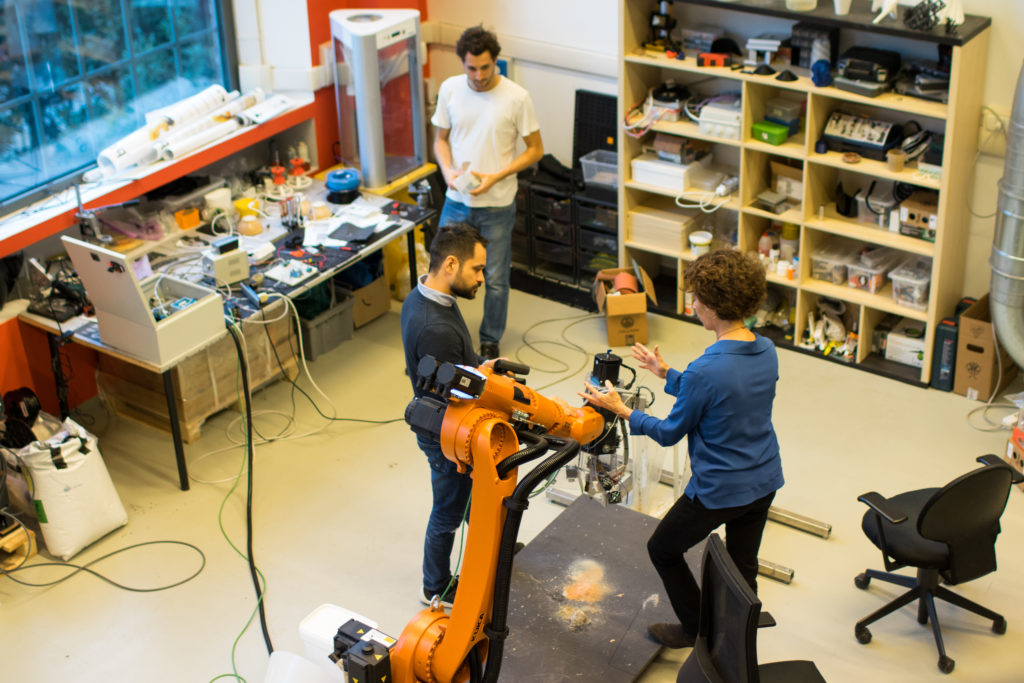
The impact of 3D printing can be felt in many manufacturing supply chains. For example, they’re working on the design of a customized ergonomic chair. Paolo Cassis, one of Caracol’s founders, explains that they would start by scanning your body and back and using the data, elaborate it digitally to produce a chair, with millimeter accuracy, via the robot and the 3D printer. For a cost of a few hundred euros.

Another example of efficiency with this manufacturing process is the creation of a simple clamp, which affects the performance of a robotic arm. Caracol printed a clamp which is much lighter than the piece traditionally made of metal. Their clamp, installed on the robot, has allowed companies to save money as the the robotic arm is lighter and can achieve the same results as larger, more expensive robots.

This doesn’t mean that they don’t value the way things used to be done, in fact, they believe that the value of tradition should be carried forward even in an innovative field like 3D printing, precisely because a beneficial collaboration between tradition and innovation can be an engine of the progress of design.

Peace is the way – Interview with Deepak Chopra

By features

Deepak Chopra is injecting peace into the world through his 21 day guided meditations. How effective are they? A new cycle has just started in Italy, where I live.

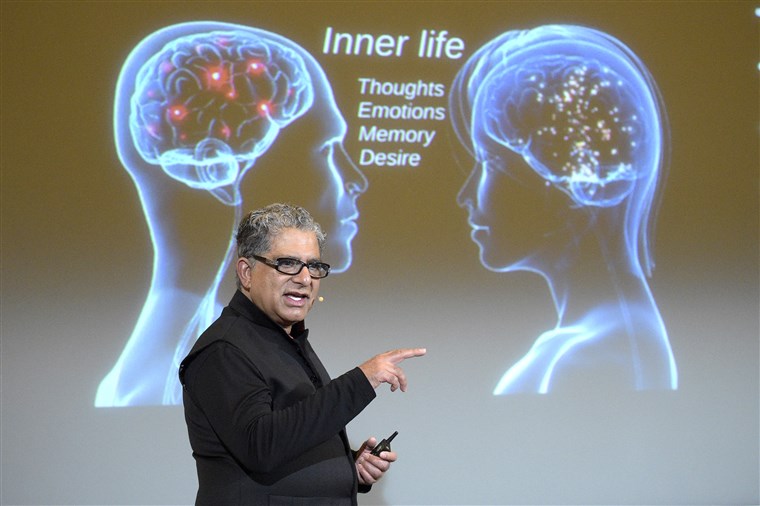
I went to the source and asked Mr. Chopra, the mastermind of many tools that are spreading consciousness, to explain how neuroscience is proving the health benefits of meditation.

As you delve deeper into how our brain and body work, how do you measure the value/positive effects of meditation?

We evaluate the benefits in the mind and the body in terms of the growth of our wellbeing. For example, we can now see the metabolic markers and hormones associated with the decrease in inflammation in the body through meditation. We can also measure the increase of the enzyme telomerase which preserves the length of telomeres sustaining healthy cell life throughout our bodies.

What are the golden rules to harness the benefits of meditation?

The basis to gaining the full benefits of meditation is to not force or push the mind, by concentrating on thoughts or resisting thoughts. Meditation is an opportunity for the mind to be present and aware of its own nature. For a successful meditation experience we only need to follow the practice with complete ease.

How did your critical mass grow over the years with the meditations you offer?

The participation in the 21 day meditation experience has grown quickly in the last few years. To date, over 4 million people around the globe have participated in the meditations, learning about it online, through social media, or word of mouth.

Which are the areas of the world that respond the most? That you have most participation from?

Presently the areas of the world most responsive to the 21 day meditation challenge are North America, but there is growing participation in all the English-speaking populations of the world, Western Europe, India, Australia, and New Zealand.