The following conversation was published in Italian in my fourth book A passo leggero which explores empathy as a driver of positive change. Professor Rizzolatti and his team at the University of Parma discovered the mirror mechanism in 1995.
——-
Mirror neurons are brain cells that are activated both when an action is performed (I eat a piece of chocolate) and when such action is observed by another person (I look at you while you eat a piece of chocolate). Not only: they respond to the purpose of an action and the intention, which is reflected at the level of motion (as I watch you grab the piece of chocolate the muscles in my mouth activate before you open yours). Mirror neurons allow us to feel what the other person is feeling.
The experiments that led to the discovery of the mirror mechanism were possible thanks to the onset of Magnetic Resonance Imaging (MRI), as it allows scientists to measure blood flow to the different areas of the brain in real time. Rizzolatti’s research began with apes and proves that, in humans, even the quality of the observed action is mirrored. This offers new insight into the principle of emulation that underlies learning.
Unsurprisingly, my conversation with the Professor took place through an empathic chain. I created a contact for a friend which led to funding for a world peace concert.
She reciprocated by connecting me with Professor Rizzolatti, who agreed to discuss the possible applications of his research with me.
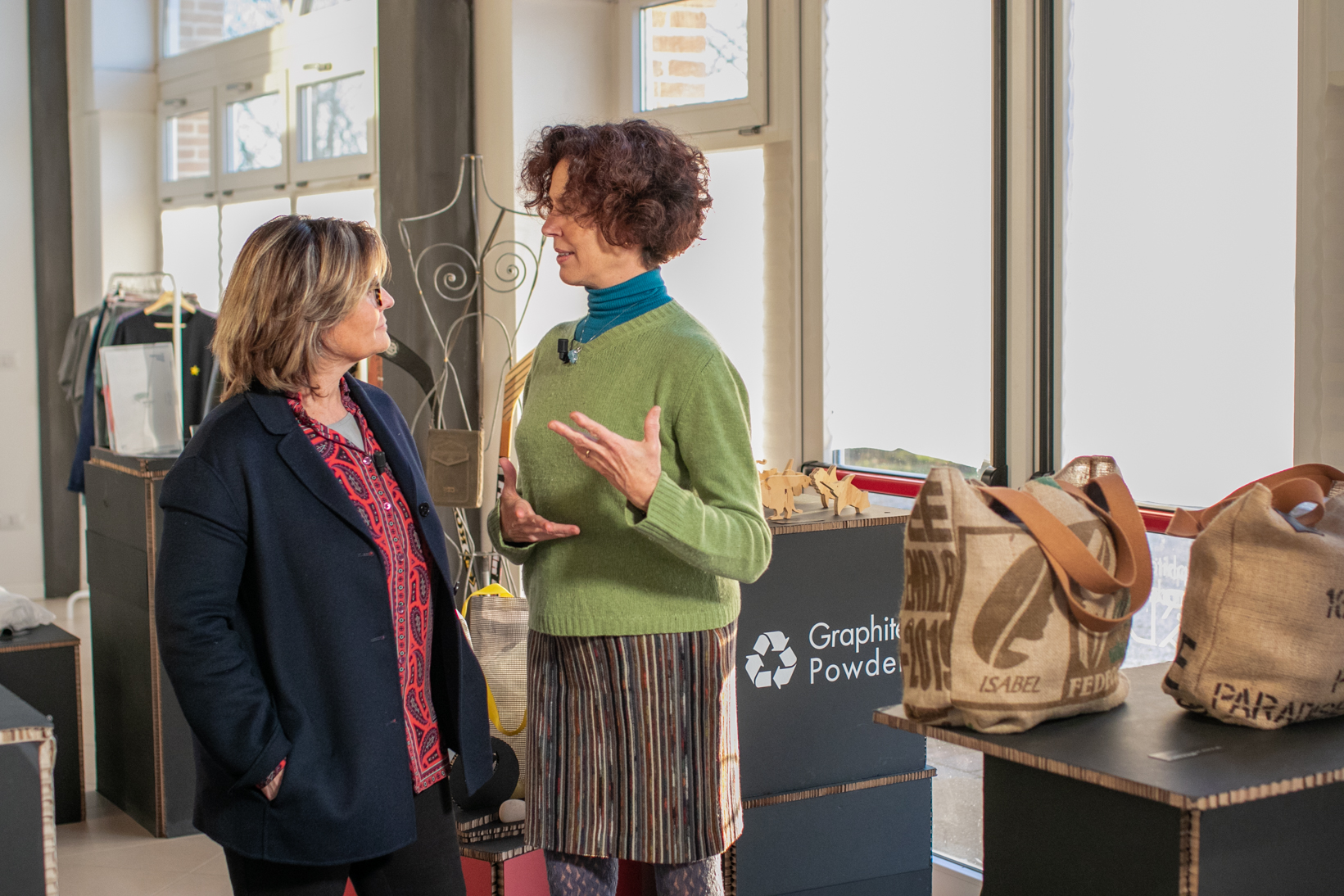
He received me in his studio in Parma. He was just as I imagined: spirited white hair, a frank disposition and an intense gaze.
He reminds me of Einstein. He speaks with both hands and body. He listens, attentive and curious, he speaks openly and generously.
Professor, your discovery seems to have revolutionized the field of neuroscience, and not only
Perhaps it happened at a time when there was a need for change, and people were seeking a scientific foundation for something they felt.
How did you come up with the name “mirror neurons”?
Actually – – – I don’t know! It’s one of those mysteries … I think we used it at some point in the lab. Honestly I don’t know how it came about. It was born by itself. We didn’t think, as a journalist might, of good branding. Anyway, it was a stroke of luck, because the name was very well received. Like calling a car “Panda” … It just works.
I thought you were referring to the Mirror Stage theorized by Lacan, the phase in which the child observing himself in the mirror understands that he is “I”…
No, we hadn’t thought about that.
Economist Jeremy Rifkin built the Empathic Civilization theory on your discovery, and neuroscientist Vilayanur Ramachandran wrote that mirror neurons are for psychology what DNA is for biology.
Rifkin loves our data, but I’ve never met him. Ramachandran is a unique character, a creative scientist, a communicator like no other! To hear him talk… is magical. At conferences we sometimes have ten-minute sessions, and many attendees refuse to talk, saying that it’s not enough time, while he manages to put on a show in those ten minutes and dissect his topic bringing together methods, results and ideas. It’s beyond belief.
Is he empathic?
Terribly empathic! And to think that when he started writing about our group we hadn’t even met yet … it’s incredibly generous for a scientist to speak highly of another scientist’s work.
According to Ramachandran, it was mirror neurons that favored the so-called cultural “Big Bang” that occurred about 50-100,000 years ago, when homo sapiens, in a relatively short time, invented fire and language and began to use tools.
This is his great idea, yes. And I think there’s a lot of truth – oh God, in something like this you cannot talk about true or false – however, I agree that human beings became cultural animals when they learned to imitate their fellow humans. When we know how to imitate others, first we want to be sure that, if we’ve invented something, our children can own it, then our neighbors can adopt it and finally, that the invention consolidates. Furthermore, as some psychologists have pointed out, imitation is a mechanism of identification, thus reinforcing the social bond in a tribe, which becomes more cohesive. Therefore, a technological, a social and a psychological advantage. In short, imitation is … how to put it … a brilliant “trick” that nature devised to make us as we are, different from all other animals.
And to also accelerate evolution…
Without a doubt. Think of the slowness of the Egyptian civilization: for two thousand years they more or less did the same things; then with the Greeks and the Romans there was an acceleration, up to the current, frightening one. You see, when imitation means that in some way you and I feel equal and we understand each other – this has been well studied in child development – your death is my death too. I build a grave because I cannot bear your disappearance. Then came religion, the need to make you stay … while if you’re an animal, it matters less. It’s one of the great mysteries: why did everything suddenly happen together? We began to draw, to celebrate rituals, religions were born … If it is true that, at a certain point, community acquires a new meaning and, as Martin Buber said “you and I become the same thing”, then it’s understandable why we need religion to ensure survival – – I will see you again in the next world.
So, the core is empathy, the empathic relationship, which creates affection, then belonging and sharing …
More than anything, belonging: I believe that animals also have a certain degree of empathy. But the key is belonging, the you and me. Clearly, if one member of the tribe suffers, they all suffer.
But if you are empathic, you feel terrible nausea…
You feel terrible nausea, surely. But what matters is mirroring the other. We are the same thing.
Boundaries are broken.
Yes, boundaries are broken. That is, they were already broken before, with mirror neurons, but in a very limited way. In fact, if I understand your action, your intention, maybe I’ll try to cheat you… this is why the ethologists of Saint Andrews, with Byrne and Whiten, speak of “Machiavellian intelligence”. It was already present in chimpanzees, in gorillas, but later it became something more, because there is participation with imitation: what I do, you do too. There’s something that unites us. Why was religion born? Some evolutionists say: it’s a language. Okay, but even if you communicate better, what’s your need for religion? Instead, if you and I are the same thing, therefore bound, your loss becomes a terrible blow … And then the tribe, the group, wants a temple, a place where the dead return. I think this is beautiful. “For whom does the bell toll? It tolls for thee”.
In how many areas of the brain are mirror neurons present?
Well, instead of mirror neurons, we should talk about mirror mechanism, thanks to which certain neurons transform what I see into my movements, so the perception of the external world becomes my own personal knowledge. Here lies the difference between the ability to understand using mirror neurons and the ability to understand through logic, which is an abstract procedure. As for the mirror mechanism, we know that it is present in emotional areas, the insula and the loop of the cingulum, and then in the parieto-frontal circuits that are linked to the understanding of other people’s actions. The first experiments we did concerned grasping. A Belgian researcher, Guy Orban, has recently found a cortical area that responds when I see someone climbing, and a more dorsal mirror region where the legs and body are represented …
Is this mirror mechanism present in everyone? Since birth?
I would say yes, we all have mirror neurons, unless there is a serious pathology.
And what can inhibit their development, their manifestation?
Society. In reality, we are all determined by our biological nature and by culture. So, all of our behavior has two roots, which come together and form personality. If society is well organized, the positive things related to our biological nature develop, if they are poorly organized they do not develop, they are severed.
Is it better to have physical contact between people to awaken the mirror neurons?
Absolutely. Even videos work, but they are much less effective: the neurons are activated much more if you do an action physically in front of a monkey or a person – on the other hand, for our purposes, filmed materials are much easier to use: we can accelerate sequences or slow them down, manipulate them, show things that do not exist in nature…
Is there a particular type of gesture that tends to activate them more?
Unfortunately, mostly violent ones. Examining the film, The Good, the Bad and the Ugly, a group of Israeli researchers found that the brain is more active when it sees a gun firing, and things like that. We also did a study starting with two commercials: in the first, a man eats a cracker, a voluptuous girl arrives (adding another element of interest), makes him smile, then all of a sudden, she steals the cracker and runs away. In the second video the characters are the same, but this time the girl asks kindly for the cracker. Well, cortical activation is much stronger when that kind of micro-violence occurs. Even though it’s clearly a joke … the brain responds a lot more.
Which part of the brain is activated?
Emotional areas, of course. If you show the cracker after the sequence, the impact is much stronger because the whole brain has awakened as a result of this micro-violence… When advertisers plan their commercials, they sense which the most effective mechanism is. I don’t know how, but they know, otherwise why would the girl steal the cracker instead of asking for it politely, with a smile?
How do mirror neurons behave with this little invasive gesture?
They see it, they reflect it, then they activate the emotional areas, it’s a process of amplification.
And what follows is remembered more easily.
Yes.
And what about a humorous twist instead of the invasive stimulus? I heard that if you make someone laugh, the information that follows sticks better.
It’s the surprise element that works. Kindness is not as effective, maybe because there’s no surprise, I do not know…
Though in today’s world, kindness can be a surprise…
True! Especially among teenagers, perhaps kindness could work!
Is it that we know less about positive feelings?
Well, yes. Currently we know a lot about pain or disgust and very little about positive feelings… It’s much easier to work on negatives.
Why?
Well, evolutionary psychologists say that “negative” is much more important. If I see someone with a disgusted face, it means that the food the person is eating could hurt me, if I see an expression of pain it means that there is something potentially harmful and I have to be careful. While, if I see two lovers… well, good for them, but I remain indifferent. If I’m good, I’ll be happy for them, if I’m jealous I’ll think: lucky guy… In general, from an evolutionary point of view, happy people leave us indifferent, but people who have problems could create problems for us too.
So you can use empathy in an instrumental way…
Well, propaganda often does, right? Think of seals. Baby seals are cute, therefore lend themselves to propaganda in favor of animals… The poor rat is continually daubed, millions are killed, but we never see mice that are killed because they wouldn’t cause empathy, while twenty seals have an amazing effect because they look like children, therefore killing a young seal becomes a crime. Americans discourage reporters from going to war zones because they fear that when the photographs circulate – – the cruelty of war is emphasized when you see it. Words are less effective than images – it’s one thing to say that three people were killed, it’s another to see them…
We all know about negative propaganda…
Think of Hitler! He brought a population of “good” people, educated, with a great artistic and scientific tradition, to become monsters, or in any case, to not see what was happening. Through propaganda he managed to deactivate the empathic drive of an entire nation…
When one thinks of the pogroms or Nazi concentration camps, it is hard to believe that empathy is a biological factor inherent in human beings…
Well, it was through propaganda that Hitler managed to convince an entire nation that Jews were not human beings. He insisted on the differences, indoctrinating people with the idea that those differences showed that Jews were inferior beings, and here propaganda was able to reset the biological factor… According to some, Hitler’s great fortune was also that he had a newly invented means of communication: radio. It allowed him to reach millions of people and was even more authoritative precisely because of its novelty: “They said it on the Radio!”.
What is the relationship between power and empathy?
I think a powerful person exploits a kind of generalized empathy. Someone said that great revolutionaries love humanity, not human beings. It’s true, because if you love humanity and you do not love those around you, when someone hinders your great dream of humanity you mistreat or eliminate them. It’s also in Dostoevskij’s Demons. There is this degeneration of idealism, this contradiction between ‘I love humanity’ and ‘I am a superman so I kill these people for the good of humanity’. Empathy is somehow eliminated for a “higher” end and turns into its’ opposite.
Do you think the dream of an empathic society is possible?
More than possible: necessary. Our society needs empathy like never before. First of all, because with technology the possibility to harm others has increased – one person can destroy an entire airport, an airplane can crash into a skyscraper. If you think about it, it’s almost a miracle that terrorism is under control and there are not more crazy people doing terrible things. As society becomes increasingly complex, there is greater need for empathy, otherwise the possibility of destruction is infinite.
Nowadays even the happiness index seems to be at historical lows…
Very true. Psychoanalyst friends tell me they have patients who are successful industrialists and who seek therapy because they feel deeply unhappy. They say: “I’m not appreciated as much as I deserve to be, I’m much better than that, I feel extremely dissatisfied”… these people are successful, they have money, yet they go to a psychoanalyst to be consoled.
Then it should be even more important to investigate the dynamics of happiness.
It would be very interesting, but wouldn’t it be a task for sociologists more than scientists? We can give a scientific basis, but we can’t replace them.
Why not?
Because widespread unhappiness is a social problem, and traditionally social problems are treated by sociologists, or possibly by psychologists or psychoanalysts… until very recently neurophysiologists were not interested in the relationship between two people, they were only interested in the individual.
However, professor, your discovery broke barriers, you’ve had the most incredible reactions from totally different fields…
Yes, it’s true.
Isn’t that a sign that it’s time to break them, these barriers between fields?
Yes, that’s right, the answer is yes. And it’s happening, also on an experimental level: for example, now CT scans are being performed on two people at the same time. It’s a funny thing, the two enter together as if they were in bed, and you can simultaneously read the two brains while they interact. The tendency is to no longer study the individual alone, as an information processor, but rather as a social being, to see what happens in the relationships between two people – more than two is currently impossible, technology does not allow it.
Are there any experiments that suggest correlations of a different type from those ascertained so far between the observer and the observed?
Well, you must know that we have neurons that respond both when we are touched directly and when the space around us is touched. For example, the same neuron activates whether you touch my nose or simply bring your finger close to my nose. Around us, there is like an air bubble, and in fact we get annoyed if someone gets too close, we feel an intrusion in our space. There is a Japanese researcher, now with us in Parma – Hiroaki Ishida – who discovered that if someone invades my personal space, while the monkey is watching me, the same neuron activates in him as if his space were being invaded. It is a very interesting mirror mechanism because it is related to corporeity: not only do I “take ownership” of your action, your body becomes mine. Not only does your action become my action, your body and my body are similar. Everything seems to converge towards the evidence that we are much more bonded with one another than we believe… it’s society that then tends, in every way, to destroy this biological tie – – our society.
In terms of society, in your opinion, what are the factors that have historically deactivated the empathic mechanism in individuals?
I think that a deep transformation occurred with the Berkeley revolution … clearly this is my personal opinion, I’m not saying this as a scientist, but the student movement started a radical change – of course, the primary motivation was right, there was a reaction to a traditional model, women wanted to be free, but freedom must be linked to a social relationship. It’s a problem if by freedom we mean “there is only me”. Or rather, it’s okay when you’re a teenager and you’re freeing yourself from your parents, but when you’re over thirty, if you do not have a partner, if you do not have a family, if you do not pursue social milestones, something to believe in, the ability to recognize oneself in another lessens. Men followed, but I think it was essentially a feminist revolution. In some ways, a carefree attitude during college has become a life model… I did not go to college in the US, but just watching movies about that time, you get the sense of freedom, full of intellectual stimuli but without responsibilities except preparing for exams… but then you grow up, you marry, you have children, and that life is hard to live…
So, was there an absence of values?
More than an absence, I would say an overvaluation of the ego. My generation, when marrying, had the idea of creating something stable and definitive. In a certain way, wives became part of the family, even if families were already not as numerous as before… Now getting married has become a kind of temporary contract.
Perhaps it’s also an effect of the religious crisis…
Well… when I was young, the religious aspect already counted less. Mostly, in intellectual environments. The idea was to start a small society, something that lasted, with the hope of having children. It’s not as if we went out together just because we liked sleeping together. It was a mini project that fed into collective ones we believed in at the time. This revolution, which started in the ‘60s with protesting individualism, in the ’80s turned into right-wing individualism: who cares, the only thing that matters is to become rich… but now it seems to me that there is a return to the idea that, after all, we do need each other. When I speak in public, I feel the enthusiasm of people who say: so we aren’t so bad, so selfish… There is this need to believe in mutual assistance, and it’s not something I find only in scientists, but in everyday people… not only in the elderly who might feel abandoned and happy to talk about these things, but in many young people.
You spoke earlier about large families: perhaps today’s need for social empathy is also linked to the progressive shrinking of families, to the affirmation of so-called “atomic” families, made of one or two people…
Indeed, the concept of family also created a kind of umbrella for the protection of elders. There was the aunt, the grandmother, but it was also a social parachute – the unemployed uncle lived with them… During my childhood, every Sunday at five, my parents and I went to visit my grandparents and we had tea together. I remember coming home from a soccer game and having to go visit them. This was already long after the war… Now, I don’t know, when my grandchildren come to see me it’s just because they need something, or maybe to play, but they don’t come every Sunday at five… that link is now missing…
Those were important rituals…
Rituals have disappeared completely, right? Yet, they were necessary to stay together. If you know that every Sunday at 5 you visit your grandparents it becomes a habit, like Christmas or other rituals that have been preserved. When instead you leave everything loose, in the end you don’t go because one time you have something else to do, another time you have a headache…
How many children do you have?
Two. A son and a daughter. Both have their own children.
Social bonds change… Today we have social networks.
Is this good or bad?
What do you think?
Well… I’m afraid it’s more bad than good. It seems to me that a person to person relationship, vis-à-vis, physical contact, creates a stronger bond than what you can achieve with someone online. I mean, I would not want this to end up isolating us…
You don’t have to tell me. When you have teenage children, it’s hard not to notice…
For example, my oldest grandson is fourteen years old now and at times I think I’ve almost lost him, because when he was five or six he liked spending time with me, we would play with soldiers, he would come looking for me… Now that he goes to high school, he comes for lunch because my daughter lives out of town, but as soon as he’s finished eating he gets up, goes to his room and sits at the computer, with Skype and so on… He certainly has friends, sometimes they go out in the evenings, but he passes most of his time with… his computer.
Collectively, do you think empathy has increased or decreased?
It’s a very complex conversation. I recently attended a symposium on empathy in Heidelberg, and a Czech friend pointed out how the concept of empathy has changed. Currently, it’s much more social. If one of our soldiers dies in Afghanistan, it’s a national drama, while during the First World War generals had no empathy for soldiers, and sent them to die because they did not consider them equals. I think there was the aristocratic idea that the noble class – the officer – was a different kind of man. The current concept that everyone should have the right to health, was an inconceivable form of empathy one hundred years ago. Once there was charity: good people gave money. Now, social empathy has become almost mandatory. You know what? Perhaps it has also become more institutionalized. Somehow, we care less about others because we think: there is the National Health Service, there are firemen… the direct help that was necessary in the past doesn’t exist anymore and this has made us less empathic.
Ah, this is an interesting point…
We have delegated empathy to public services: the State must take care of health, education, safety and the well-being of citizens: it results in a lack of responsibility …I look after myself and delegate everything else to the institutions, but I get angry if the service does not meet my expectations. Another factor, perhaps more in Italy than elsewhere, could be the collapse of the communist party. For many young people it was a moment of aggregation, a way to come together with an idea of a better society. They went to sell l’Unità in the morning, took part in action groups… Now it’s like an American political party, the aggregation is over….
And what about the workforce?
Well, there are jobs where empathy must necessarily be reduced: special forces undergo training to be un-empathic, otherwise how could they intervene? Not that they become monsters, but the moment they’re holding the baton and receive an order, they cannot be swayed by blood or a girl crying. Sometimes we are socially bound to diminish empathy, but it should be limited to these special work forces, not normal citizens. Whenever I’m in an airport, I’m amazed at the thought of all those people who line up and follow orders… When that volcano with the unpronounceable name erupted in Iceland, I was returning from Poland and was stuck in Vienna. One might think that in such a dramatic situation people would try to get one up on each other, instead, a really interesting empathy emerged… We helped each other, we looked for information and passed it on: “There’s a train to Innsbruck! Let’s take it, from there we can reach Verona…” the point is that today’s society is so complex that it can no longer afford individualism.
Unfortunately, we not only feel separated from each other, but from nature…
Do you find that we are separated from nature? I don’t think so…
Well, we are overturning our Planet’s balance with a certain degree of indifference…
Maybe, but the upper class continues to go to the mountains and enjoy nature. In novels from the 1800s the poor lived in dirty and polluted cities, while now, they can afford a trip out of town…
So, you do not believe that loving nature is a natural instinct?
Honestly, it’s a pretty big leap from love for others to love for nature…
Shouldn’t we feel a kinship with nature?
Well, speaking in terms of evolution, do you think that this problem has ever been posed? No, nature was a given, it was just there. It’s only our generation that has begun to pose the question… I believe that concern for nature is more of an intellectual construct…
But without plants we can’t breathe…
OK, but we don’t think that way. It’s not as if we think about the function of chlorophyll.
Shouldn’t we also acknowledge the role of plants? Feel empathy for them as living beings?
But here mirror neurons have nothing to do with it!
It would be interesting to check if mirror neurons are activated when I see an oak tree being cut down.
(Long silence) You have a point. Actually yes, since the oak is a living being, when one gets cut down we would be sad, without a doubt. Even seeing a child trampling flowers without any reason strikes us – then, yes, we empathize, but because at that moment we almost consider the oak like a living being… that is, it is a living being… but we almost see it as an animalesque figure.
Only this?
I would say yes, it’s almost a physical phenomenon, because the oak is there, it’s a living being and seeing it die… takes something away from us … yes, in that sense, we are one with nature. But if trees have to be removed to build a highway, it is no longer empathy… one must evaluate the pros and cons, weigh the economic benefits.. It becomes less immediate, a logical process that has to be solved by a sociologist or a politician. I, Giacomo Rizzolatti, cannot decide if it’s right to build the Turin-Lyon highway. But with the example of the tree, I admit, you caught me off guard…
Let’s go back to the possible applications of mirror neurons – maybe a little far fetched. Don’t you think that your discovery has somehow validated the power of visualizations?
What do you mean?
In meditation techniques, we are taught to visualize what we want to happen, create mental sequences that activate an inner resonance to forge a path towards completion…
Well… the French neuroscientist Marc Jeannerod introduced a distinction between motor imagery and visual imagery. Motor imagery is when I think of myself doing something: here I get very similar results to those of mirror neurons, I activate the same areas, while if I simply see or imagine a static thing, the effectiveness is much lower.
This would coincide with techniques of personal growth through visualization, which require imagining oneself performing an action.
In fact, motor imagery – imagining doing something – is extremely powerful, almost as powerful as seeing it happen. Although, there isn’t much scientific basis for what you’re talking about. A German researcher, Tania Singer, director of the Max Planck Institute in Leipzig, has been doing experiments on meditation… but I don’t think she has gone far with it…
Is studying what happens when someone performs a motor visualization part of your field?
Yes, it was done in France. Jeannerod had actually thought of a rehabilitation technique for those affected by paralysis: they had to imagine moving. The results were there, but for the patients it was tiring. We do something similar, but our method involves three moments: seeing, imagining, doing. That is, I see someone perform an action that I can not do because I am paralyzed, I imagine I do it, then I perform it to the best of my capabilities. And it works pretty well.
Do you know the story of the D’Angelos? They live in Milan. A few days after the birth of their son, they discovered that the baby had had a prenatal stroke in the right hemisphere of his brain.
Oh wow, how sad…
They too have somehow applied your discovery…
Yes, but… it’s not magic, unfortunately…
Yes, but do you know what they did? They used themselves as a model for the child and the results were stunning.
What amazing people! What wonderful insight – to use themselves – because they have the same way of moving, the same genes – it would have been much less effective if they had used a stranger as a model. We would like to do something similar using technology, involving parents and relatives… The D’Angelos really deserve a prize.
Speaking of which, congratulations for the Brain Prize that you just received in Copenhagen! A yearly recognition for neuroscientists that have distinguished themselves in their field. What does it mean to you?
I was happy both for myself and for science in Italy which, despite difficulties, remains of high value. And, the prize figure is huge.
One million euros: higher than the Nobel prize, which has recently been reduced. How will you spend it?
Technically it would all be mine, but it doesn’t seem right to simply pocket it. I thought I would assign a part of it to a research fund in the neuroscience department. The bureaucracy has become unbearable and the only solution to work efficiently is to have resources outside of the university’s administration. We actually have a Canadian who wanted to buy a piece of plastic, he needed it for an experiment. Cost: thirty euros. They told us that we had to follow the procedure established by the “spending review”. Wait time: a couple of weeks. In short, either we pay out of our own pockets or we stop working. I can’t tell you the process if we need professional services! We have to ask permission from the rector, who must make an announcement to the whole university to see if someone volunteers for free, then, because obviously no one volunteers, a call for bids is made, we then wait twenty days for it to become public, and then finally it goes to the Court of Auditors for approval. Basically, if I want a statistical analysis I have to wait three months. In Germany, you get it in one day. They treat us like the land registry or the Ministry of Transport, where perhaps it’s logical to put a cap on spending, but for a piece of plastic…
For ordinary expenses there should be a department manager who verifies that it’s not wasted.
Of course, but the university administration lacks trust. In Anglo-Saxon countries it’s all about trust – it’s clear that if you do something wrong, then you’re done. With us, between spending reviews and the Gelmini law, it’s practically impossible to work. The fund I want to create will also provide for these little things.
Regarding the Gelmini reform, in 2008 she put forward an important proposal on the university system and research.
Yes, I suggested abolishing tenure and establishing a system where every five years you’re reviewed by a commission. If you’re competent, you can stay until you’re ninety years old, otherwise you could even be sent home at fifty. I want to re-launch this proposal. Six years ago I received many letters from young people who said: you’re quite selfish, you’ve reached tenure and now you want to control us. I thought I had favored them, because if you send away a series of 50-60 year-olds who don’t do anything, then you have more room for young people. Merit is a key concept for academia – perhaps for other public offices there might not be a big difference between one employee and another, but between two university professors, yes. It’s the system in force at Riken, a Japanese research center of the highest level, equal to a university. There are no qualms, they summon you and say: your scientific production is not considered adequate, we’re giving you two years to find another place.
Shouldn’t empathy also be a key ingredient in classrooms, between professors and students?
Fundamental, but all teachers know this.
Yes, but how many are empathic in your experience? Let’s be realistic…
Well… we are still attached to the idea that it’s enough to be proficient in your subject to be a good teacher. But it is equally important to know how to teach. Even a doctor should not just inquire about your medical history but must know how to ask the questions – understand you to understand your illness. The same goes for a judge. We tend to consider this two separate things, and to underestimate the latter. But good teachers are those who can foster enthusiasm in their students. If you give them nothing, they don’t learn. The empathic relationship is fundamental.
How many forms of empathy have you classified so far?
Well, actually… having to summarize, I would say there are three forms of empathy. First of all emotional empathy, that is empathy that makes us “suffer together” or “feel together”, which is what made the discovery of mirror neurons popular. Then there is the empathy we call “cognitive”, the ability to understand others according to their actions, which involves both identification and objectification: I understand you both because you are human like me and because you are an object that does something; this ability varies according to the relationship between the observer and the observed – for example, if you are my girlfriend, I probably understand you better. Finally, the so-called “vitality forms” are very important for us, a name that is owed to the psychoanalyst Daniel Stern and concerns the “quality” of minimal gestures. If at the dinner table I ask you to pass the salt, how you react informs me if you are in a good mood, distracted or aggressive. We had never studied the quality of a gesture before Stern, and both for us and for child psychologists, how is fundamental, it is the beginning of a social relationship. When the child still has no logical skills, he understands how. Among other things, it is the kind of empathy that seems to be lacking in high functioning autism, those without cognitive deficits but that are missing an important link to reality…
So it’s a mechanism that completely ignores cultural cues… It would be nice to further investigate the quality of gestures in a social sense as well, in everyday life…
Of course, acts of kindness are important… I am convinced that more kindness with our spouses, children, or when we order our coffee in the morning, would already change the world. Instead of “Coffee!”, “I’d like a coffee, please.”
Let’s change the idea that a positive attitude is boring. We could develop research based on the question “Does kindness work?”
Why not? It’s a beautiful title.